








News
Forthcoming Events
Previous News Items
Past News Items and working party updates can be viewed by clicking HERE.
Dates For Your Diaries, a number of events throughout the coming year.
Previous news items / working party updates can be viewed by clicking HERE
A working party of nine volunteers gathered near Hartley West Farm this morning for another river clearance session, on a fine sunny day – with birds singing and spring flowers blooming.
Storm Dave had done its worst and blown two trees into the river. The first one was just upstream of the waterfall. We couldn’t get the main trunk out, but, after removing branches, we winched it to the side of the river. The river is not all that deep at that point so waders weren’t needed (although wellies were).
Photograph A. River blockage
Photograph B. Clearing blockage
The end result was a couple of big piles of branches and twigs either bank and a clear river.
The second tree had fallen right across the river at the straight section between the lower wooden footbridge and the stepping stones. This one was a big one! Some others had removed the branches across the path, leaving us with little to do.
We removed some of the remaining branches with bowsaws and piled the debris on dry land. The trunk was still in the river, right across its width, but we don’t have access to chainsaws nowadays, so we can’t do much more about that problem.
We’re sometimes asked why we remove timber from the river – “why not let the river be natural, logjams and all?” Well, logjams tend to be litter traps, and we can’t bear to leave lots of litter floating on the river – it’s unsightly and bad for wildlife. We could leave the blockages in place and just remove litter, but that would be prohibitively time-consuming.
Leaving timber in a river works well in up-country rivers, but it doesn’t work so well in the urban-fringe setting, where litter is more of a problem. We are open to suggestions on this dilemma, but meanwhile we feel obliged to keep the river clear.
Anyway, today was a good one for wildlife. The warblers are in from Africa and are singing their heads off! – blackcaps and chiffchaffs in particular. Also singing were robins, wrens, great tits, blue tits and a song thrush. A woodpecker was heard calling; also rooks, jackdaws and a pheasant. And the mallards were very active, flying up and down the river in pairs inspecting our work.
On a sunny spring day all the flowers open out, and today it was the old springtime favourites of celandines, anemones and bluebells, among others.
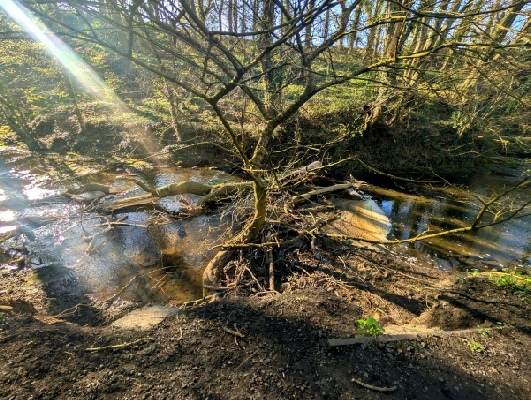
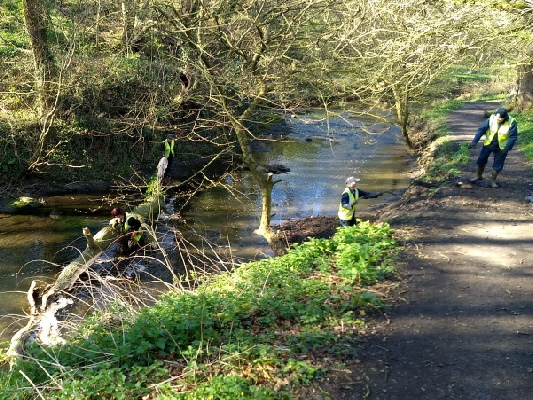
Spring sunshine greeted the working party this morning (although there had been an overnight frost). Eleven of us met up at the metal gate on the Hartley West Farm road to do some river clearance, sycamore removal and litter picking.
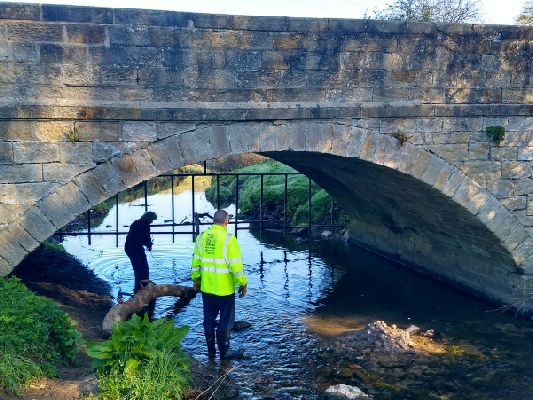
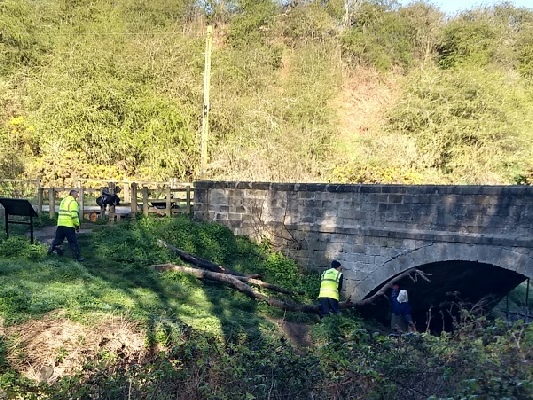
The team co-ordinator and two others set off for the stone bridge where there was a log jammed against the cattle gate (which keeps the cows from wading up the river and into the Dene). Some splashing around in wellies and waders was necessary to get it and other bits of timber out, and the winch had to be deployed to provide extra pulling power.
Photograph A. Clearing under stone bridge
Photograph B. Winching log out
This activity only took part of the morning session, after which the amphibious three joined the other volunteers who had started hunting down and removing sycamores.
Sycamores are a non-native tree species which tends to reproduce prolifically and out-compete the other trees, so we remove seedlings, saplings and the lower branches and twigs of the mature trees – although it is beyond our capabilities to fell the full-grown trees.
In actual fact, we found very few seedlings or saplings and it’s not clear why that is, as sycamore seedlings are coming up in large numbers elsewhere. Perhaps in the Dene seeds are being eaten by voles or squirrels or badgers before germinating; who knows?
We did find lots of litter however, especially along the top of the Dene, near the Hartley-Earsdon road. Along with the usual aluminium cans, plastic packets and bottles, and wine and beer bottles, we found a kiddie’s tricycle! The litter was bagged up and (with the trike) placed next to one of the litter bins for collection.
We couldn’t help noticing in that the spring wildflowers are flourishing in the mixed sunny and showery April weather. It will soon be the turn of the bluebells, which are coming up in masses on the steep slopes on the south side of the Dene between the stone bridge and the lower footbridge.
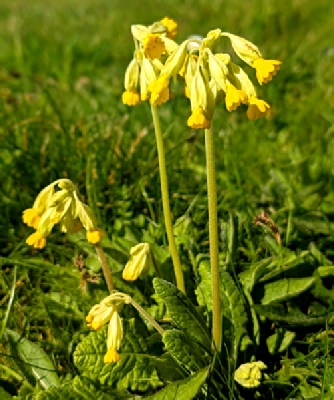
Cowslips are flowering well at present:
Photograph C. Cowslip
and a comma butterfly was spotted:
Photograph D. Comma butterfly
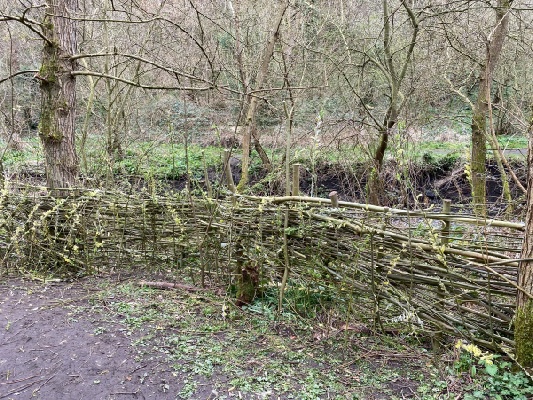
The working party this morning continued last week’s sycamore removal project, this time on the north side of the Dene. The nine volunteers assembled at the metal gate on the Hartley West Farm road before setting off on their quest.
As I’m sure you know, we control sycamore trees in order to prevent them from taking over from other trees in Holywell Dene. They are notoriously “spready” and not native to Britain. We can’t do anything about the large numbers of mature sycamore trees already in the Dene but we can, and do, remove seedlings and saplings.
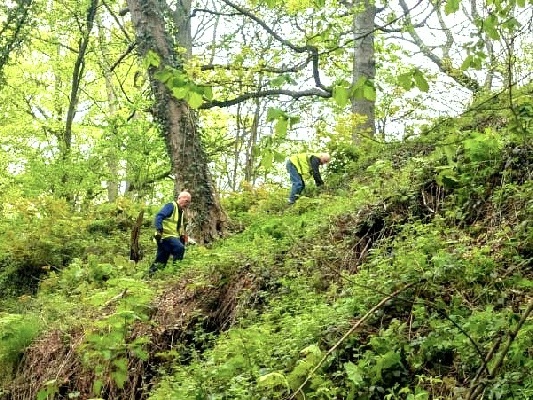
So, armed with saws of various types we started out from the meeting place and proceeded as a group, with our wheelbarrows, slowly up the north side. The slopes here are steep and tangled with brambles and other impediments, so it was necessary to move around carefully.
Photograph A. Removing sycamore saplings
We found that there were swathes of first-year seedlings in some places but very few in most other places – and we are not sure why. However there were plenty of saplings of various ages, right up to larger ones that might be called mini-trees and that needed to be felled with a bowsaw. But, generally, a pruning saw or a pair of loppers was all that was needed.
We must have removed several hundred seedlings, at least, and of the order of a thousand saplings in the session. We also removed side-twigs from established trees.
Photograph B. Removing side-branches/twigs
When we got to the lower wooden footbridge we found that an old hawthorn had fallen across the path so we removed it. Much less litter was encountered this week, but nevertheless we collected it up and removed it.
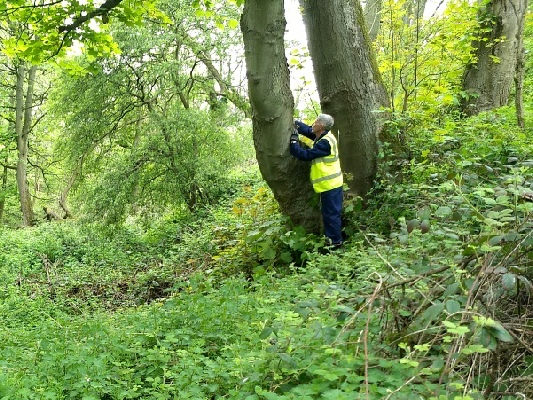
Oh, and by the way, we also removed some ivy in one or two places to prevent it getting too much of a hold on the trees in the Dene.
Photograph C. Removing ivy from tree
The wildlife scene was very different from how it was only a month ago. There was a distinct sense of the beginnings of the buzz of summer. The small birds
were singing, flowers were blooming and insects were buzzing. We noticed that the bluebells were beginning to flower and they will probably be blooming en masse in a couple of weeks’ time.
The weather was chilly at first, but seemed to warm up considerably as the session continued – party because of the sun rising in the sky and partly because of the warming effect of exercise. The Dene is always sheltered from chilling winds.
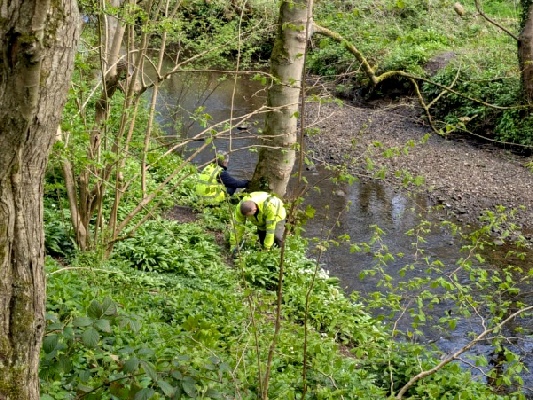
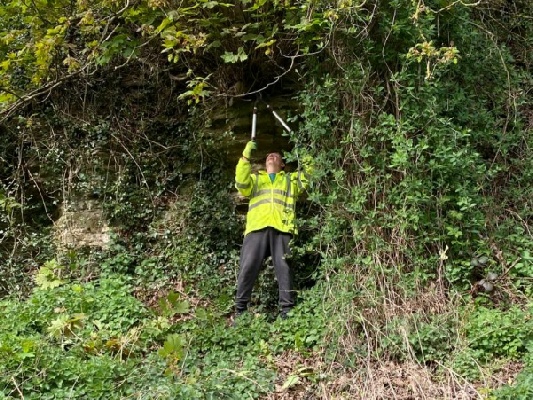
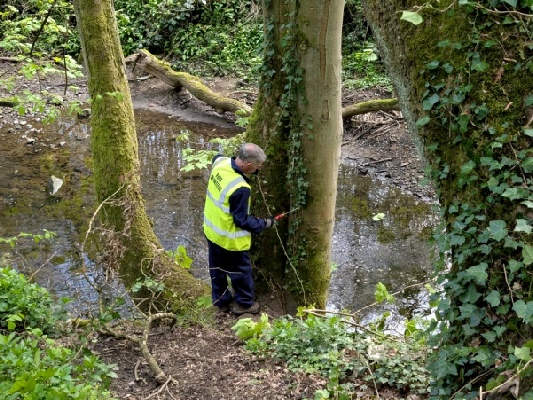
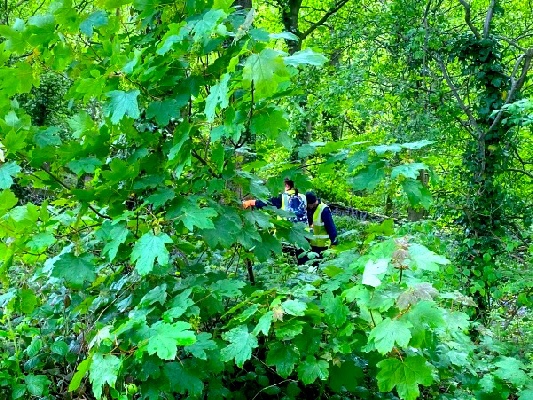
A party of 11 volunteers met up at the Northumbrian Water pumping station at the end of Holywell Dene Road for more sycamore cutting, ivy bashing and general tidying up.
We were working on both banks behind the pumping station where the kids ride their bikes. The weather was overcast and we were trying to predict if the massive black cloud in the distance was coming our way and if we would get a full session in!
We split into two groups to tackle the jobs using hedge shears, secateurs and bow saws. As stated previously, we prune the sycamores to give the plants underneath a chance of some sunlight so they can flourish.
Photograph A. Sycamore sapling (and volunteers)
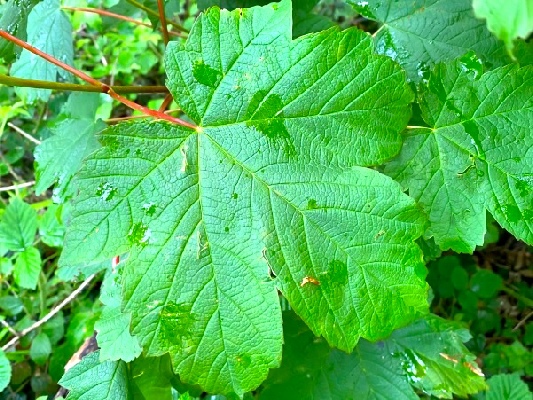
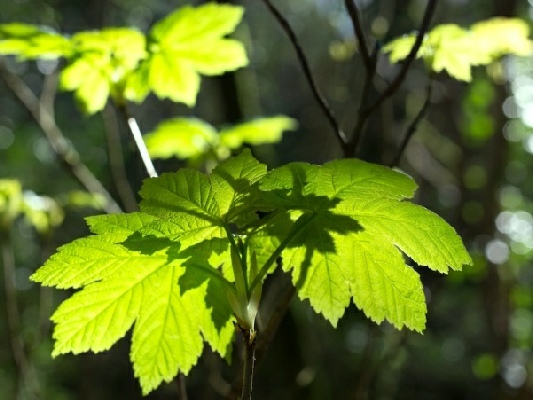
Photograph B. What a sycamore leaf looks like
As we go along we also remove any ivy growing up the trunks of trees by cutting a gap about 8 inches long as low as we can get, to kill the ivy and lighten the weight on the tree.
We also gathered up any plastic bottles and aluminium we came across, filling up a couple of bin bags, which we dropped of at the council bin at the end of the lane.
By the way, one of us found and pulled up the first Himalayan balsam of the year.
The working party of eleven volunteers continued sycamore-bashing this morning, on a dull and slightly chilly day.
The Northumbrian Water pumping station near Holywell was the venue for this morning’s meet-up. We parked the van in the parking space kindly provided by Northumbrian Water and got the tools ready. At the appointed hour of nine o’clock, off we went pushing our wheelbarrows laden with tools as usual.
The destination was a point on the north bank near the waterfall, which is where we left off last week. The work, as last week, consisted of grabbing a pair of loppers or a saw and clambering up the steep slope to find and remove sycamores.
Photograph A. Hunting down sycamore saplings
Photograph B. What we’re looking for
These might be seedlings, small saplings that can be pulled out, or a larger ones that can only be clipped off close to the soil so that they are unlikely to regrow. We also removed sycamore twigs and branches growing from the base of mature sycamore trees.
Sycamores are magnificent trees, but they are non-native and tend to take over in mixed woodland like Holywell Dene. So we try to control their numbers.
Photograph C. A volunteer sycamore-bashing (with a bit of AI enhancement!)
We have now cleared the north side from about the stone bridge to the tunnel. We must have removed thousands.
We think we are winning. Not many sycamores are found that are are intermediate in size between one that can be cut down with a bowsaw and a big mature one, which suggests that, over the years, we have succeeded in preventing saplings growing into mature trees.
We also removed some ivy from trees, by the way – another thing that needs to be kept under control.
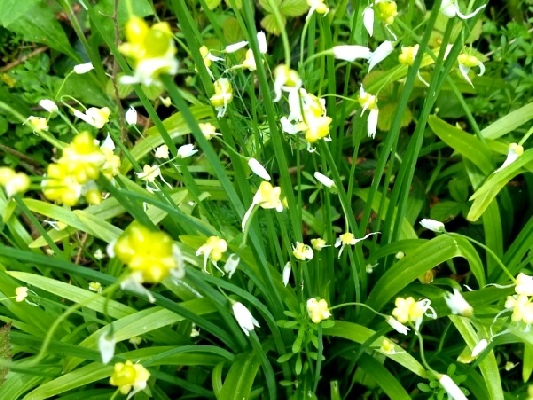
We’ve spotted a new invasive foreign weed in the Dene recently, by the way. It’s called few-flowered garlic (Allium paradoxum) and it tends to crowd out the flowers on the woodland floor. Here’s a picture.
Photograph D. Allium paradoxum
We’ll have to learn how to control it.
The wildlife event of the day was the discovery of a mallard duck’s nest half way up the dene slope. We moved away as soon we realised what it was. It has always been a puzzle how mallards can nest in the Dene despite the disturbance caused by people and dogs – by nesting at a distance from paths and in a well-concealed position, apparently.
We’ll be back for more adventures next week!
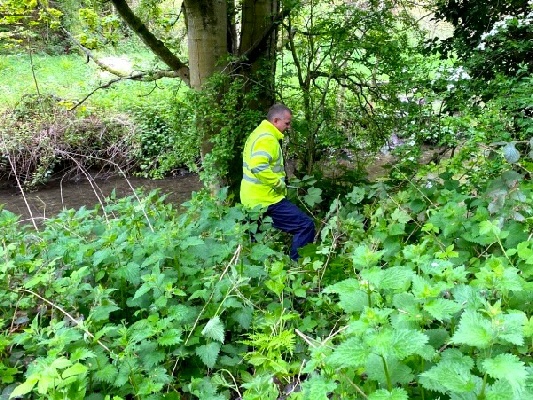
The task this morning, for the working party of eight, was the same as last week: removing sycamores – on a rather dull but dry day.
We started where we left off last week – more-or-less at the downstream wooden footbridge – and worked upstream from there on the north side all the way up (almost) to the waterfall.
It was hard going, for two reasons: (1) the terrain was steep and tangled with brambles, and (2) there were lots (and lots) of sycamores – far more than we found on the south side on the 14th.
Most of these were saplings – easily pulled up or cut off at the ground level. Some had obviously been there for several years. Well, it’s several years since we did “sycamore bashing” there. The Dene’s a big place and sycamores can pop anywhere.
Photograph A. Removing sycamore saplings
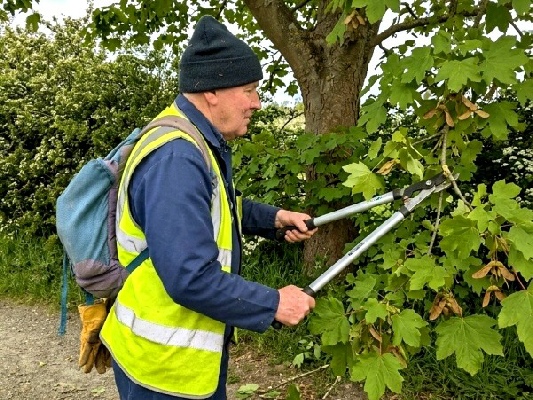
As usual, we also removed side-growths from mature sycamore trees.
Photograph B. Removing side-growths
The spring wildflowers were in bloom and that somewhat compensated for the difficulty of the task. Here’s a (probably incomplete) list: bluebells, lesser celandines, wood anemones, dog violets, wood sorrel, wild garlic, dandelions, garlic mustard.
The small birds were making their presence felt as well – robin, wren, willow warbler, chiffchaff, great tit, song thrush, blackbird, etc.
| Flowers |
| Trees |
| Fauna |